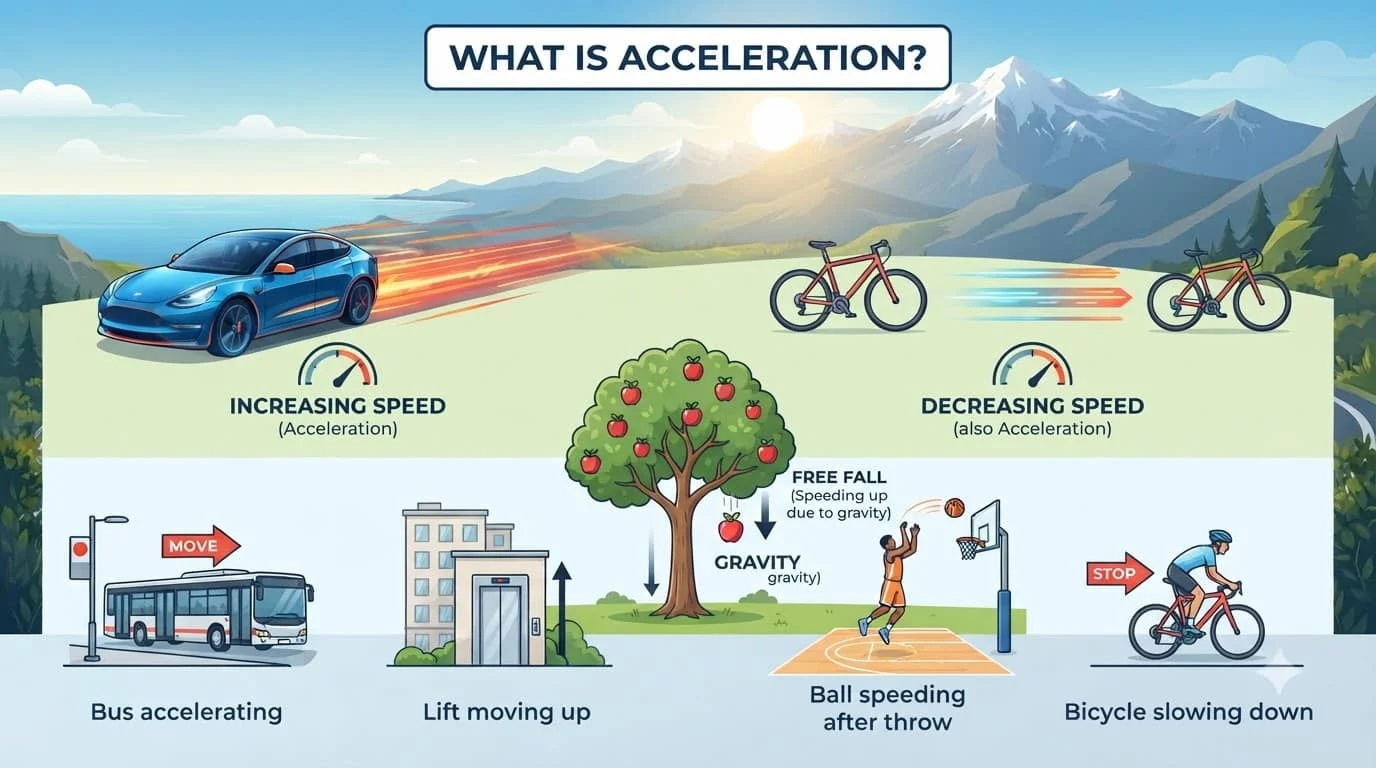
Acceleration means a change in speed. First, think about a bike or car. If it goes faster and faster, that is acceleration. Also, if it slows down, that is acceleration too. However, this time speed goes down, not up. Next, this change can happen the same way every second. We call this uniform acceleration. Sometimes, the change is different each second. So, we call this non-uniform acceleration. Then, think about falling things. Earth pulls them down with gravity. Therefore, they speed up as they fall, like an apple from a tree. Finally, we see acceleration daily, like a bus speeding up or a lift moving up.
What is Acceleration?
Acceleration meaning is simple. It tells us how fast the speed changes. In other words, it shows a change in speed.
So, what is acceleration in physics? Physics is the study of things around us. It is one small part of physics. First, think of a bike. If a bike goes faster and faster, that is acceleration. Also, if a bike goes slower, that is acceleration too. However, this time speed goes down, not up.
Think about a ball now. When you throw a ball, its speed changes fast. Therefore, we call this change acceleration. In short, acceleration is all around us.
Formula of Acceleration
A formula is a short way to show an idea. Acceleration also has a simple formula.
a = (v − u) / t
This formula means one thing. Acceleration equals the change in speed, divided by time. Here, “divided by” means we split one number by another number.
| Symbol | Meaning |
|---|---|
| a | Acceleration |
| u | Starting speed |
| v | Ending speed |
| t | Time taken |
Each letter has one small job. First, “u” means the speed at the start. Next, “v” means the speed at the end. Then, “t” means how much time it took. Finally, all three letters together give us “a”.
SI Unit of Acceleration
A unit tells us how we measure something. So, we need a unit for acceleration too.
It’s unit is meter per second squared. We write it as m/s². This unit shows how much speed changes in one second.
| Quantity | SI Unit | Symbol |
|---|---|---|
| Acceleration | meter per second squared | m/s² |
| Speed (velocity) | meter per second | m/s |
| Time | second | s |
First, speed is measured in meter per second. Next, time is measured in seconds. So, when we divide speed by time, we get m/s².
Types of Acceleration
Acceleration is not always the same. It has different types.
- Positive Acceleration: Speed goes up.
- Negative Acceleration (Deceleration): Speed goes down.
- Uniform Acceleration: Speed changes the same way every second.
- Non-uniform Acceleration: Speed changes in a different way each second.
- Zero Acceleration: Speed does not change at all.
| Type | Meaning | Example |
|---|---|---|
| Positive | Speed goes up | Car speeds up |
| Negative | Speed goes down | Bus stops |
| Uniform | Same change every time | Free fall |
| Non-uniform | Different change every time | City traffic |
| Zero | No change | Car moves at same speed |
What is Acceleration Due to Gravity?
Gravity is a pulling force. Earth uses gravity to pull things down. So, acceleration due to gravity means the speed change caused by this pull.
What is acceleration due to gravity? It is the speed a falling thing gains from Earth’s pull. First, Earth pulls every object toward itself. This pull works like an invisible string.
Next, what do you mean by acceleration due to gravity? It simply means a falling object gets faster and faster. This happens because of Earth’s pull. Near Earth, this value is:
g = 9.8 m/s²
This means a falling object gets 9.8 m/s faster every second. For example, an apple falling from a tree gets faster because of this pull.
Factors That Affect Acceleration
Some things change how fast acceleration happens. Here are the main things:
- Force: A bigger push gives more acceleration.
- Mass: Mass means how heavy a thing is. A heavier thing needs more force.
- Gravity: Earth’s pull adds acceleration to falling things.
- Friction: Friction is a force that slows things down. It can reduce acceleration.
Difference Between Speed, Velocity, and Acceleration
These three words look similar. But they are not the same. So, this table will help you.
| Feature | Speed | Velocity | Acceleration |
|---|---|---|---|
| Meaning | How fast a thing moves | Speed with direction | How fast speed changes |
| Direction | Not needed | Needed | Needed |
| SI Unit | m/s | m/s | m/s² |
| Example | Car moves at 40 km/h | Car moves 40 km/h north | Car speeds up by 5 m/s every second |
First, speed only tells us how fast a thing moves. Next, velocity also tells us the direction. Finally, acceleration tells us how fast that speed changes.
Real-Life Examples of Acceleration
We see acceleration every day. Here are some simple examples:
- A car starts moving from rest.
- A bike goes faster on an empty road.
- A bus goes slower near a stop.
- A lift moves up in a building.
- An apple falls down from a tree.
- A ball moves fast after a hit.
- An airplane speeds up before it flies.
- A roller coaster moves fast going down.
- A runner starts running at the race line.
- A bicycle slows down before it stops.
Applications of Acceleration
Acceleration is useful in many places, not only in books. Many people use this idea every day.
- Cars: Engineers use acceleration to make good engines.
- Sports: Players train hard to run faster and faster.
- Space rockets: Rockets need big acceleration to leave Earth.
- Engineering: Workers use acceleration to build safe machines.
- Physics: Acceleration helps explain how things move.
- Aviation (flying): Airplanes need acceleration to fly into the sky.
- Daily life: We feel acceleration in cars, lifts, and bikes.
Important Motion Formulas
Motion means movement. Physics uses some formulas to explain motion. These formulas use speed, distance, and time.
| Formula | Use |
|---|---|
| a = (v − u) / t | Finds acceleration |
| v = u + at | Finds the final speed |
| s = ut + ½at² | Finds the distance moved |
| v² = u² + 2as | Connects speed, acceleration, and distance |
Each formula solves one problem. Together, they help us understand motion better.
Key Points to Remember
- Acceleration means the change in speed.
- The formula is a = (v − u) / t.
- The unit of acceleration is m/s².
- Positive acceleration means speed goes up.
- Negative acceleration means speed goes down.
- Uniform acceleration means the same change every second.
- Non-uniform acceleration means a different change every second.
- Zero acceleration means no change at all.
- Acceleration due to gravity near Earth is 9.8 m/s².
- Force and mass both change acceleration.
- Friction can slow down acceleration.
- Speed has no direction, but velocity has direction.
- Acceleration also has a direction, like velocity.
- Cars, lifts, and falling things show acceleration.
- Motion formulas help us solve movement problems.
Conclusion
In short, acceleration means how fast speed changes. Its unit is m/s². Also, it has many types, like positive and negative acceleration. Gravity makes falling things speed up at 9.8 m/s². Finally, acceleration helps us understand cars, sports, and even rockets in space.
Frequently Asked Questions (FAQs)
1. What is acceleration?
Acceleration is the change in speed with time. For example, a car speeding up shows acceleration.
2. What is acceleration in physics?
In physics, acceleration shows how much speed changes each second. It also has a direction.
3. What does acceleration mean?
Acceleration means a thing gets faster or slower. So, it shows a change in motion.
4. What is acceleration SI unit?
The SI unit of acceleration is meter per second squared. We write it as m/s².
5. What is acceleration unit?
The unit of acceleration is m/s². This tells us how much speed changes each second.
6. What is the formula of acceleration?
The formula is a = (v − u) / t. Here, “v” is the final speed, and “u” is the starting speed.
7. What are the types of acceleration?
The types are positive, negative, uniform, non-uniform, and zero acceleration. Each type shows a different change.
8. What is positive acceleration?
Positive acceleration means speed goes up. For example, a car speeding up on the road.
9. What is negative acceleration?
Negative acceleration is also called deceleration. It means speed goes down, like a bus stopping.
10. What is acceleration due to gravity?
It is the acceleration a falling object gets from Earth’s pull. Its value is 9.8 m/s².
11. What do you mean by acceleration due to gravity?
It means a falling object gets faster because of gravity. This happens near the Earth.
12. What is uniform acceleration?
Uniform acceleration means the speed changes the same way every second. Free fall is a good example.
13. What is non-uniform acceleration?
Non-uniform acceleration means the speed changes differently each second. City traffic often shows this.
14. Why is acceleration important?
Acceleration is important because it explains how things move. Also, it helps build cars and rockets.
Leave a Reply