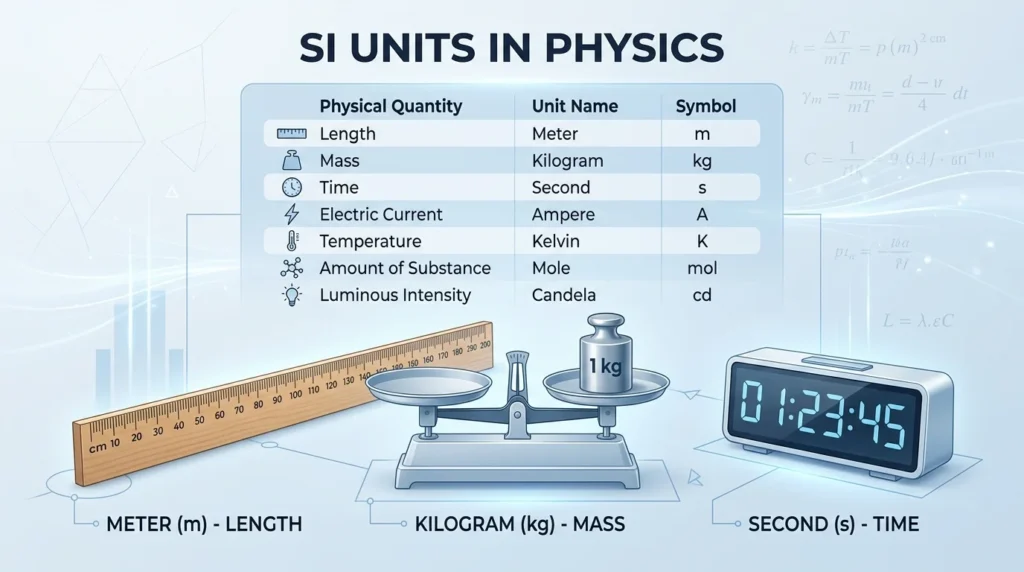
SI Units are special units for measurement. Scientists use these Units all over the world. They help us measure length, mass, time, and many other things. Every country uses the same SI Units. So, science becomes easy for everyone. In this article, we will learn about these units in very simple words.
What are SI Units?
SI stands for “International System of Units”. This name comes from the French words “Système International”. Scientists created this system to make measurement simple. Before SI Units, different countries used different systems.
This created confusion in science and trade. So, scientists made one common system for the whole world. Now, every scientist uses the same SI system of units. This makes calculations and experiments much easier.
The si measurement system has seven base units. All other units come from these seven units. Because of this, SI Units connect all fields of science together.
SI Base Units
The table below shows the seven SI base units.
| Quantity | SI Unit | Symbol |
| Length | Meter | m |
| Mass | Kilogram | kg |
| Time | Second | s |
| Electric Current | Ampere | A |
| Thermodynamic Temperature | Kelvin | K |
| Amount of Substance | Mole | mol |
| Luminous Intensity | Candela | cd |
- We measure length in meters. It tells us how long or how far something is.
- We measure mass in kilograms. It tells us how heavy an object is.
- We measure time in seconds. It tells us how long an event takes.
- We measure electric current in amperes. It tells us how much electricity flows through a wire.
- We measure temperature in kelvin. It tells us how hot or cold something is.
- We measure the amount of substance in a mole. It counts tiny particles like atoms.
- We measure light brightness in candela. It tells us how bright a light source is.
Common SI Derived Units
Derived units come from the seven base units. The table below shows common SI derived units.
| Quantity | SI Unit | Symbol |
| Force / Weight | Newton | N |
| Frequency | Hertz | Hz |
| Electric Charge | Coulomb | C |
| Electric Potential | Volt | V |
| Inductance | Henry | H |
| Capacitance | Farad | F |
| Resistance | Ohm | Ω |
| Electrical Conductance | Siemens | S |
| Magnetic Flux | Weber | Wb |
| Magnetic Flux Density | Tesla | T |
| Energy / Work / Heat | Joule | J |
| Power | Watt | W |
| Angle | Radian | rad |
| Radioactivity | Becquerel | Bq |
| Luminous Flux | Lumen | lm |
Newton measures the force or weight of an object. Hertz measures how many times something repeats in one second.
Coulomb measures electric charge on a body. Volt measures electric potential or push of electricity.
Henry measures inductance in an electric circuit. Farad measures capacitance, or how much charge a device stores.
Ohm measures resistance, or how much a material blocks current. Siemens measures conductance, or how easily current flows.
Weber measures magnetic flux around a magnet. Tesla measures magnetic flux density in an area.
Joule measures energy, work, or heat. Watt measures power, or how fast work happens.
Radian measures angles between two lines. Becquerel measures radioactivity in a substance.
Lumen measures luminous flux, or total light from a source.
Why SI Units Are Important
SI Units give the same measurement everywhere in the world. Because of this, a scientist in India and a scientist in Japan understand each other easily.
SI Units make science simple and clear. Also, they help in easy trade between countries.
Students learn better with one simple system. Therefore, SI Units make education easier for everyone.
These also make calculations very quick and simple. So, communication about measurement becomes clear and correct.
Benefits of SI Measurement System
- SI Units are accepted all over the world.
- They remove confusion between different measurement systems.
- They make scientific experiments accurate and reliable.
- They help students learn physics easily.
- They make international trade smooth and simple.
- They help engineers build things correctly.
- They make daily life measurements simple, like weight and length.
- They connect different fields of science together.
Examples of SI Units in Daily Life
- Height is measured in meter.
- Rice is measured in kilogram.
- Time is measured in second.
- Milk is measured in litre, which comes from cubic meter.
- Room temperature is measured in kelvin.
- Electric current in a wire is measured in ampere.
- Energy in food is measured in joules.
- The power of a bulb is measured in watts.
- The speed of a car is measured in meters per second.
- Force used to push a door is measured in newton.
Conclusion
SI Units are simple, standard units for measurement. They help scientists, students, and traders use the same system worldwide. The si system of units removes confusion and makes science clear. Learning these helps students understand physics better. Every student should learn SI Units for a strong science foundation.
SI UNITS – NUMERICAL PROBLEMS
Q1. Convert 72 km/h into m/s.
Ans. 72 km/h = 72 × (1000 / 3600) = 20 m/sQ2. The density of a substance is 5 g/cm³. Convert this into SI Units (kg/m³).
Ans. 5 g/cm³ = 5 × (10-3 / 10-6) = 5000 kg/m³Q3. Find the dimensional formula of force using SI Units.
Ans. F = ma, so [F] = [M][LT-2] = [MLT-2]Q4. Using SI Units, check whether the equation v = u + at is dimensionally correct.
Ans. [v] = [LT-1], [u] = [LT-1], [at] = [LT-2][T] = [LT-1]. Since all terms match, the equation is dimensionally correct.FAQs on SI Units
The SI system units is the International System of Units, the world’s standard measurement system. It has seven base units — meter, kilogram, second, ampere, kelvin, mole, and candela — used globally in science.
SI units full form is International System of Units.
There are 7 base SI units and 22 derived units with special names.
The SI unit of acceleration is meter per second squared (m/s²). It tells us how fast speed changes every second. For example, a falling ball speeds up by about 9.8 m/s² near Earth.
The SI unit of momentum is kilogram meter per second (kg·m/s). It shows how much motion an object has. A heavy truck has more momentum than a small bicycle at the same speed.
The SI unit of conductivity is siemens per meter (S/m). It tells us how well a material carries electric current. Metals like copper have high conductivity.
The SI unit of density is kilogram per cubic meter (kg/m³). It tells us how much mass fits in a given space. Water has a density of about 1000 kg/m³.
The SI unit of force is Newton (N). It measures the push or pull on an object. We use newtons to measure how hard we push a cart.
The SI energy unit is joule (J), named after scientist James Joule. It measures work, heat, and energy together. One joule is a small amount of energy.
The SI unit of mass is kilogram (kg). It tells us how much matter an object has. We buy vegetables and fruits in kilograms.
The SI unit of pressure is pascal (Pa). It measures force applied on a certain area. Air pressure and water pressure both use pascals.
The SI unit of temperature is kelvin (K). Scientists use kelvin because it starts from absolute zero. Normal room temperature is about 293 K.
The SI unit of electric current is ampere (A). It tells us how much electric charge flows per second. A mobile phone charger uses a small current in amperes.
The SI unit of length is meter (m). It measures distance or size of an object. We measure the length of a table in meters.
The SI unit of magnetic flux is weber (Wb). It measures the total magnetic field passing through an area. Weber helps in studying magnets and motors.
The SI unit of power is watt (W). It measures how fast energy is used or produced. A light bulb of 60 watts uses energy quickly.
Leave a Reply