Introduction
In physics, velocity means how fast an object moves in one direction. Many students only know the word “speed.” But it is something more than speed. First, It also tells us the direction of motion. So, it gives full information about movement. In this article, we will learn velocity in very easy words.
What is Velocity?
How This Idea Began
Long ago, thinkers like Aryabhata studied motion using only distance and time. Gradually, scientists wanted a quantity that could show speed and direction together. That is how velocity came into existence.
Velocity meaning
In physics, velocity is the change in position (displacement) divided by the time taken. Therefore, whenever position changes in a fixed direction over time, this rate becomes easy to calculate.
SI Unit of velocity
Meanwhile, the unit stays the same as speed — metre per second (m/s), and sometimes kilometre per hour (km/h).
Speed vs. Velocity
Speed only tells you how fast something moves. However, this new idea tells you two things at once: how fast, and which way. So, in short, it is speed plus direction combined.
For example, a car moving at 60 km/h has only speed. But a car moving at 60 km/h to the north has velocity. Therefore, the direction is the main difference between speed and velocity.
In Short
- Speed = how fast
- Direction = which way
- Together = a complete picture of motion
Thus, whenever an object moves steadily in one direction, this idea remains simple, useful, and easy to understand.
Velocity-Time Graph
A velocity-time graph shows that how an object’s velocity changes with time. The x-axis represents time, while the y-axis represents velocity.. The slope of the graph gives acceleration. and the area under the curve gives displacement. This graph helps students see motion clearly. It also makes speed changes easy to understand. And it shows acceleration in a simple, visual way.
Types of velocity
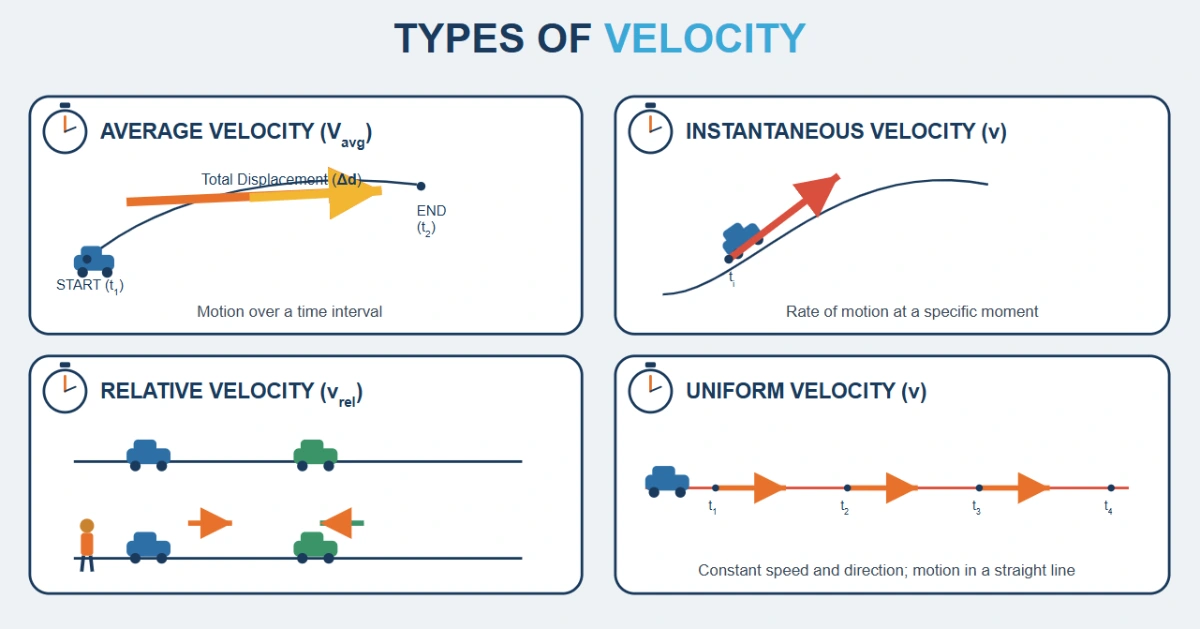
Long ago, scientists noticed motion is never simple. Sometimes speed changes; sometimes direction shifts. So, thinkers split this idea into two clear types. First, they defined a smooth, overall measure across a journey. Then, they defined a precise value at one single moment. Thus, both types together explain real-world motion easily.
Average Velocity
In physics, average velocity is total displacement divided by total time taken. Here, displacement means the net change in position between two points. So, this value gives the overall rate of motion. However, it does not show small speed changes happening during the journey.
For example, think of a boy who walks 10 meters to the east in 5 seconds. Then, his average velocity is 2 meters per second to the east. This number shows the complete motion, not just every small step.
Instantaneous Velocity
In physics, this means how fast, and in which direction, an object moves at one exact moment. It shows the exact speed and exact direction at that instant only. So, this value can change every second during motion. When the time interval becomes very, very small, the average value turns into this exact instant value.
For example, a car’s speed meter shows instantaneous velocity all the time. It changes when the car goes fast or slow. So, this type shows a live reading of motion.
Mathematical Formula of velocity
In physics, Velocity always follows one simple rule. This rule joins displacement and time together. Let us see what is velocity formula given below.
Average Velocity Formula
v̄ = Δx / Δt = (x₂ − x₁) / (t₂ − t₁)
Here, Δx means the change in position, or displacement. Also, Δt means the change in time. So, average velocity is displacement divided by time.
Instantaneous Velocity Formula
v = lim(Δt→0) Δx/Δt = dx/dt
This formula shows velocity at one exact moment. Here, dx/dt shows how fast the position changes with time. Therefore, this formula uses a very small time part.
Simple Velocity Formula
v = d / t
Here, d means distance or displacement moved. Also, t is the total time taken. This easy form is used in simple physics sums.
Key Facts
The table below shows easy words about velocity in physics.
| Term | Meaning | SI Unit |
| Velocity | Speed of an object in one fixed direction | meter per second (m/s) |
| Average Velocity | Displacement divided by time taken | meter per second (m/s) |
| Instantaneous Velocity | Velocity of an object at one exact moment | meter per second (m/s) |
| Speed | Distance moved divided by time | meter per second (m/s) |
| Displacement | Change in position of an object | meter (m) |
Velocity shows both speed and direction of a moving object. Average velocity shows the complete motion over the whole walk.
Instantaneous velocity shows the exact motion at one moment. Speed only shows how fast an object moves, without direction.
Displacement shows how much position of an object changed. So, all these words work together to explain motion clearly.
Why Velocity Is Important in physics
Velocity helps us explain real motion in an easy way. Without it, we cannot tell the direction of moving things. So, this idea becomes very useful in physics.
Also, it helps in solving many motion sums easily. Engineers use it to make cars, trains, and airplanes. Sports coaches use it to check player speed and direction too.
Finally, this gives a strong base for learning acceleration. Because acceleration means how fast velocity changes. Therefore, students must learn it before harder topics.
Benefits of Understanding velocity
- It helps you read position-time graphs in an easy way.
- It helps you know the direction of a moving thing.
- It helps in solving physics sums easily.
- It explains real motion, like cars, trains, and balls.
- It helps in learning acceleration later.
- It makes your basics of motion strong.
- It joins physics ideas with daily life.
- It builds a good base for higher classes.
Examples of velocity in Daily Life
- A car moving north at 40 km/h.
- A ball thrown up shows changing velocity.
- A train moving on a straight track shows steady velocity.
- A cyclist riding east at 15 km/h.
- A plane flying west fast.
- A runner running to the finish line shows velocity.
- A falling stone that keeps growing.
- A swimmer moving forward in water.
- A rocket going straight up after launch.
- A bus moving south on a road clearly.
Conclusion
In physics, velocity is the speed of an object on one fixed direction. It is not the same as speed because it also shows direction. Average velocity shows full motion, while instantaneous velocity shows one moment. Both types help us understand real motion clearly. Every student should learn velocity to make physics basics strong. It also helps in learning acceleration and motion graphs later.
FAQs
1. What is velocity in physics?
Velocity means speed on one fixed direction. It has a number and a direction. Ex. A car moving east.
2. What is the definition of velocity?
Velocity shows how fast the place of a thing changes. It also shows direction. This makes it different from plain speed.
4. What is the formula of velocity?
The formula is v = d/t. Here, d means displacement. Also, t means time taken for motion.
5. What is the SI unit of velocity?
The SI unit is meter per second (m/s). It shows distance moved every second. A cyclist at 5 m/s moves five meters each second.
6. What is average velocity?
Average velocity is total displacement divided by total time. It shows full motion. It does not show small speed changes.
7. What is instantaneous velocity?
Instantaneous velocity is speed at one exact moment. It can change every second. A speed meter shows this live number.
8. What is the difference between speed and velocity?
Speed shows only how fast a thing moves. Velocity shows speed and side together. So, velocity gives more information.
9. What is the difference between velocity and acceleration?
Velocity shows speed and direction of motion. Acceleration shows how velocity changes with time. So, acceleration depends on velocity.
10. What is uniform velocity?
Uniform velocity means the same speed and direction all the time. It does not go fast or slow. A steady train shows this motion.
11. What is negative velocity?
Negative velocity means motion on the opposite side. It is not about being slow. It only shows the reversed direction.
12. What is relative velocity?
Relative velocity compares one thing’s motion to another. It shows speed from another thing’s view. Two cars coming close show high relative velocity.
13. What is the full form of velocity in physics terms?
Velocity has no full form. It simply means speed in one direction. The word comes from the Latin word “velocitas.”
14. What is zero velocity?
Zero velocity means no change in place. The thing stays fully still. A parked car shows zero velocity.
Leave a Reply